The current participating regulatory authorities
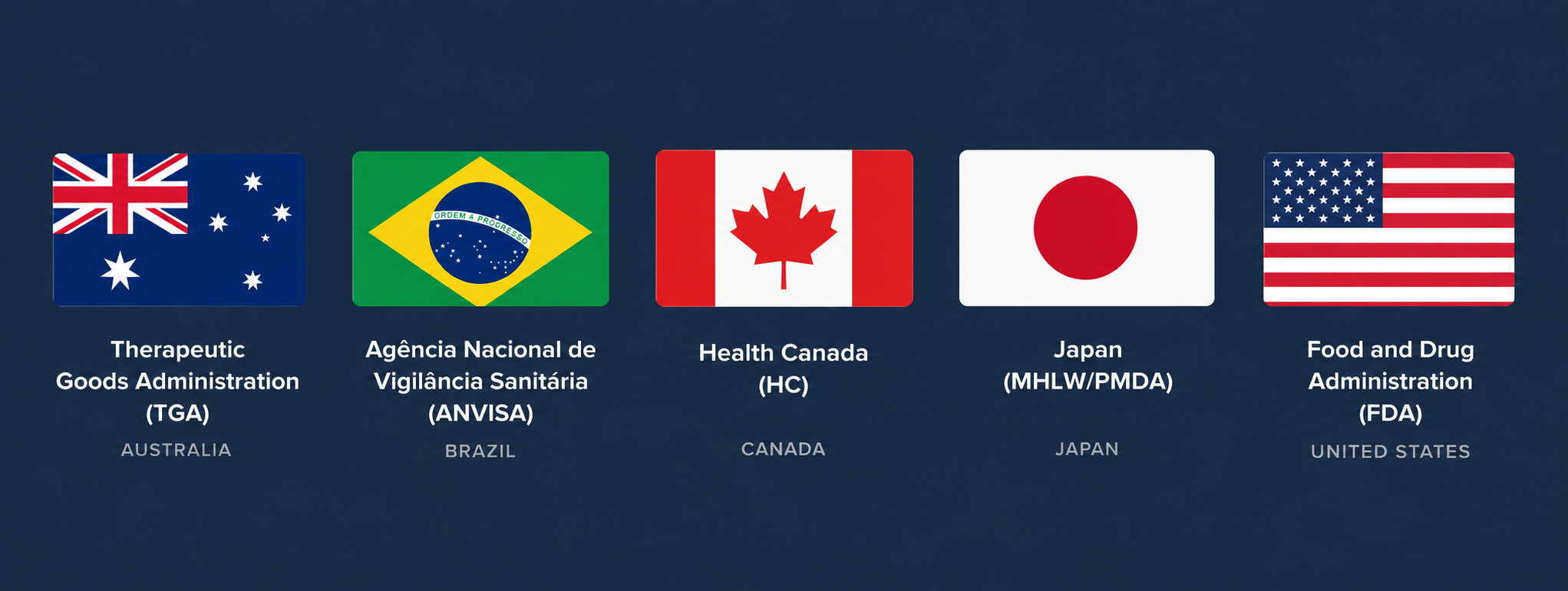
One Quality Management System. Multiple Regulatory Jurisdictions.
The Medical Device Single Audit Program enables a medical device manufacturer to have its Quality Management System audited through a single regulatory audit covering the applicable requirements of participating regulatory authorities.
MDSAP brings together the regulatory frameworks of Australia, Brazil, Canada, Japan and the United States. The audit is based on a structured, process-oriented approach that evaluates how the manufacturer's QMS operates and how applicable jurisdiction-specific regulatory requirements are integrated into its processes.
How ELLECOM Can Support You
Whether you are establishing a new Quality Management System or extending an existing ISO 13485 QMS, ELLECOM can support you in integrating the applicable MDSAP requirements directly into your quality framework.
For a new QMS, your system can be developed and implemented with ISO 13485:2016, EN ISO 13485:2016 and the applicable requirements of your selected MDSAP jurisdictions considered from the beginning. This includes the Quality Manual, procedures, responsibilities and supporting QMS processes.
If you already have an established ISO 13485 QMS, ELLECOM can perform a MDSAP gap assessment to determine what is already addressed and where additional market-specific requirements need to be incorporated. From there, we can support the necessary QMS updates, internal audits and preparation for the independent MDSAP audit.
The aim is to help you establish one Quality Management System that supports the markets you serve today and provides a strong foundation for the markets you plan to enter tomorrow.
A Clearer Approach to MDSAP
We help you navigate the MDSAP audit framework with a clear understanding of how quality management and country-specific regulatory requirements are assessed - bringing together regulatory expertise and practical QMS experience to support your organization through certification and the ongoing MDSAP audit cycle.
Explore the MDSAP and QMS topics below to understand how the individual processes work, how they connect, and how they contribute to a QMS prepared for the MDSAP audit.
-
Within MDSAP, market access is viewed as an ongoing regulatory process rather than a one-time approval. Each participating jurisdiction has its own requirements for device marketing authorization, establishment or facility registration, and maintenance of regulatory status.
An important part of this process is maintaining evidence that the device is appropriately authorized for the market in which it is supplied. The regulatory status may also need to be reconsidered when changes are introduced to the device, its intended use, design, manufacturing process, software, labelling or manufacturing facility.
This creates an important connection within the Quality Management System between regulatory authorization, change control and continued market compliance. The significance of a change determines whether it can be managed internally or whether notification, amendment, clearance or approval from the applicable regulatory authority may be required.
-
Within MDSAP, distribution is closely connected to the regulatory status of the medical device. The process provides assurance that the device being supplied, its configuration and labelling correspond to the authorization applicable in the respective market. Distribution records then provide traceability through the supply chain, while controls over distributors support continued oversight after the device leaves the manufacturer.
-
An effective QMS provides manufacturers with a way to understand how well their quality processes and products are performing in practice. Information from complaints, audits, suppliers, inspections, CAPA and other quality activities can reveal trends, recurring issues and potential problems. When a nonconformity is identified, its evaluation and investigation help determine its significance, appropriate disposition and whether further corrective action is needed, while ongoing analysis provides valuable input for QMS improvement and Management Review.
-
Adverse-event reporting connects post-market safety information with regulatory responsibilities. Potential events are evaluated for reportability and, where required, communicated to the applicable regulatory authority within defined timelines. Investigation outcomes can further connect with CAPA, Risk Management, Post-Market Surveillance and Management Review.
-
Advisory notices and recalls provide a structured response when safety or performance concerns require action for devices already in the market. The process connects risk evaluation with regulatory notification, communication to affected customers and distributors, device traceability, execution of the field action and verification of its effectiveness. Outcomes can further contribute to CAPA, Post-Market Surveillance and Management Review.
-
Production and service process controls connect device requirements with consistent manufacturing outcomes. Effective planning considers process sequence, resources, equipment, personnel, environmental conditions and appropriate monitoring. Where the resulting output cannot be fully verified through subsequent inspection or testing, process validation provides evidence that the process can consistently achieve the defined requirements.
-
Product cleanliness helps ensure that contamination introduced during manufacturing, handling or processing does not affect device safety or performance. This includes defining cleanliness criteria, controlling cleaning processes, verifying their effectiveness and preventing re-contamination during subsequent handling, packaging and storage. Where cleanliness cannot be adequately verified through inspection or testing, cleaning process validation provides evidence of consistent process performance.
-
Infrastructure and work environment provide the physical and environmental foundation for consistent medical device production. This includes suitable facilities, equipment and utilities together with appropriate controls for maintenance, cleanliness, ventilation, temperature, humidity and other environmental conditions that may influence product quality, safety or conformity.
-
Consistent medical device production depends on the connection between controlled processes, competent personnel and reliable measurement. Production monitoring and defined acceptance criteria help confirm product conformity, while trained personnel and appropriately calibrated measuring equipment provide confidence that inspections and measurements are performed consistently and accurately.
-
Document and record control provides the foundation for keeping QMS information current, traceable and accessible. It connects document creation and approval with revision control, distribution, external documents and archiving, while quality records provide evidence of activities performed and requirements achieved throughout the medical device lifecycle.
-
Personnel competence connects individual responsibilities with the knowledge, skills, training and experience needed to perform QMS activities effectively. Training needs, job-specific qualification and effectiveness evaluation help establish competence, while retraining and ongoing development support personnel as processes, technologies and regulatory requirements evolve.
-
The Device Master File brings together the current information that defines how a medical device is manufactured and controlled. It connects device specifications with production instructions, inspection and testing methods, equipment requirements, packaging, labelling and applicable servicing information, while document and change controls help keep this information aligned with the device actually being produced.
-
Production records provide the documented history behind each released medical device, lot or batch. They connect manufacturing and process information with inspection and test results, traceability, deviations or rework, and final release authorization, providing evidence that the finished device met its defined specifications before distribution.
-
Product identification and status control provide clear visibility of a medical device throughout production and handling. Identification through device, lot, serial or other applicable identifiers supports traceability, while defined status controls distinguish products that are awaiting inspection, accepted, rejected or released. This helps prevent mix-ups and unintended use or distribution of products before the required acceptance activities are completed.
-
Product control brings together customer property, acceptance activities, nonconforming product management, rework and product preservation throughout manufacturing and distribution. These controls help maintain device conformity, while distribution records provide traceability of released devices through the supply chain.
-
Servicing activities help maintain a medical device’s intended performance and safety after it has been placed in use. A structured servicing process connects service requests, maintenance or repair activities and post-service verification with documented service records. Information generated through servicing can also reveal recurring issues and provide valuable input to complaint handling, CAPA and Management Review.
-
Risk control continues beyond manufacturing and considers how transport, installation and servicing may affect the safety, performance and integrity of a medical device. Appropriate controls can address packaging and handling conditions, installation where applicable, and servicing activities, while ongoing verification helps confirm that these controls remain effective throughout the device lifecycle.
-
Purchasing controls help connect the medical device manufacturer with the suppliers and outsourced processes that can influence device quality, safety and performance. A risk-based approach considers supplier qualification, defined purchasing requirements, incoming verification and supplier performance, while appropriate change communication helps ensure that changes within the supply chain are evaluated before they can affect the medical device.
-
Supplier management provides a structured way to understand how external suppliers can influence medical device quality, safety and conformity. A risk-based approach connects supplier selection and qualification with the significance of the supplied product or service, while ongoing performance monitoring and periodic re-evaluation help determine whether approved suppliers continue to meet defined requirements.
-
Data analysis brings together quality, product and post-market information to provide a broader view of QMS performance. Information from complaints, nonconformities, CAPA, suppliers, audits, production, PMS and quality objectives can be evaluated for trends and emerging risks, providing meaningful input for Risk Management, CAPA and Management Review.
-
Changes to a medical device should remain controlled throughout the product lifecycle. A structured Quality Management System should ensure that proposed design and development changes are clearly identified, documented and assessed before implementation, considering their potential impact on device safety, performance, usability, Risk Management, manufacturing processes, suppliers, labelling, IFU and applicable regulatory requirements.
The change-control process should connect the reason for the change with a documented impact assessment, appropriate design review, verification and validation where required, formal approval and controlled implementation. The extent of these activities should reflect the nature and significance of the change. Following implementation, affected design outputs, Risk Management documentation, Technical Documentation, manufacturing and quality records should be updated as applicable, with traceability maintained from change initiation through approval and implementation. This helps ensure that changes are introduced in a controlled manner without compromising the device's approved requirements, safety, performance or regulatory conformity.
-
Reliable measurements support consistent product inspection and acceptance decisions. Calibration and verification controls help ensure that monitoring and measuring equipment remains suitable, accurate and traceable, while out-of-tolerance results are evaluated for their potential impact on previously inspected products.
-
Internal Audits and Management Review provide two connected mechanisms for evaluating the implementation, performance and effectiveness of a Quality Management System. Internal audits systematically assess whether QMS processes are implemented and maintained as planned, identify nonconformities and improvement opportunities, and follow identified findings through corrective action and effectiveness verification.
Management Review brings the resulting information together with other key QMS inputs, including customer feedback and complaints, process and product performance, CAPA, supplier performance, regulatory developments, quality objectives, post-market information and previous actions. This enables Top Management to evaluate whether the QMS remains suitable, adequate and effective, determine necessary improvements and resources, and establish actions for continued QMS performance.
Do you have a specific question about MDSAP?
Whether you are establishing a new QMS, integrating MDSAP requirements into an existing ISO 13485 system, determining the requirements for your target markets, or preparing for an MDSAP audit, our team is here to support you.
Contact us to discuss your Quality Management System, target markets and MDSAP requirements.